How Slot Free Spins Work: Multipliers and Retriggers
Last reviewed: October 2026
A free-spin multiplier increases qualifying payouts during an earned bonus. It does not multiply your balance or guarantee that the bonus will pay. A 5× multiplier turns a $2 eligible return into $10. If the spin returns zero before multiplication, it still returns zero afterward.
This structure appears in commercial slots. IGT describes the Cleopatra Bonus in Caesars Cleopatra as an opportunity to triple awards. NetEnt’s Jack Hammer gives a more specific example: free-spin line wins are tripled, and five or more Free Spins symbols can award extra spins during the feature. The precise trigger, eligible wins, and retrigger rules belong to each title. IGT’s Caesars Cleopatra announcement and NetEnt’s Jack Hammer feature guide describe those separate implementations.
Here, Tideglass Treasury, an original LearnTheOdds practice model, supplies a worked example whose probabilities we can inspect. It combines scatter-triggered free spins with a hidden 2×, 3×, or 5× multiplier. Its rules and mathematics are its own; the commercial examples above help identify the feature family.
Jump to: Play · How it plays · Bonus rules · The math · Questions
Play Tideglass Treasury
Free spins with a 2×, 3× or 5× multiplier

$1,000 practice bank · Free play · No cash value
Open a separate game in a full window ↗ Loading your game… Taking a while? Use the full-window link to open the game directly.How free spins and multipliers work
An earned free spin uses a wager already established by the triggering paid spin. No new stake is deducted for that spin, but its payouts remain part of the paid game’s overall return.
Three details determine what a multiplier means:
- What it covers: one qualifying line, every line win, a separate prize, or something else.
- How long it lasts: one spin, several spins, or the entire feature.
- What changes it: a new random selection, collected symbols, a retrigger, or nothing.
In Tideglass, a chest choice reveals one multiplier that applies to every line win throughout the free-spin feature, including extra spins. It does not change as the bonus progresses. The multiplier selected is equally likely to be 2×, 3×, or 5×.
Think of it as a fixed exchange rate for bonus awards. Once 3× is revealed, each dollar of ordinary line return becomes three dollars during that feature. The reels still have to produce a paying combination.
Paylines, wilds, and the complete paytable
Tideglass has five reels, three visible rows, and 20 active paylines. A line must contain at least three matching or eligible wild symbols consecutively from the leftmost reel. A match starting only on reel two does not pay.
The available total bets are $1, $2, $5, $10, $20, and $50 in virtual funds. Each total is divided equally among 20 lines. At a $1 total bet, the line bet is $0.05; at $5 total, it is $0.25.
Every payout below multiplies that line bet. The final column gives the number of copies of each symbol on each 36-stop reel, which we will use for the probability calculations.
| Symbol | 3 in a row | 4 in a row | 5 in a row | Copies per reel |
|---|---|---|---|---|
| Sea glass | 12× | 30× | 90× | 6 |
| Scallop | 12× | 30× | 90× | 5 |
| Coral | 15× | 35× | 100× | 4 |
| Tidal star | 15× | 35× | 100× | 4 |
| Pearls | 15× | 45× | 125× | 3 |
| Crown | 20× | 60× | 175× | 3 |
| Compass | 20× | 60× | 175× | 3 |
| Amphora | 25× | 75× | 250× | 2 |
| Lantern | 35× | 100× | 300× | 2 |
| Seahorse | 60× | 150× | 600× | 1 |
| Wild, the Current Heart | 60× | 175× | 900× | 2 |
| Scatter, the treasury chest | No line pay | No line pay | No line pay | 1 |
The Wild replaces paying symbols but never the Scatter. Only the highest qualifying award pays on each line. Awards on different lines are added.
That highest-award rule matters when a line begins with several wilds. Wild, Wild, Wild, Sea glass, Scallop can make four Sea glass for 30×, but the first three Wilds have their own 60× award. The line returns 60× the line bet once. It does not add both awards.
For a simpler example, Seahorse, Wild, Seahorse, Scallop, Coral pays 60× for three Seahorses. At $1 total bet, that line returns 60 × $0.05 = $3. If it is the only paying line on a paid spin, the net profit is $2 after subtracting the $1 stake.
The same line during a 5× bonus returns $3 × 5 = $15, with no new stake deducted. The 5× applies to the $3 line award, not to your balance or the total feature collected so far.
Scatter triggers, chest choices, and retriggers
Treasury chests count anywhere in the visible window. They do not have to share a payline, and they have no separate cash award.
| Scatters on a paid spin | Initial free spins |
|---|---|
| 3 | 8 |
| 4 | 12 |
| 5 | 20 |
After the trigger, pick one of three chests. Behind them are 2×, 3×, and 5×, placed in a randomly shuffled order before the choice. Each position offers the same one-in-three chance of each multiplier. Picking a particular position or waiting before clicking provides no mathematical advantage.
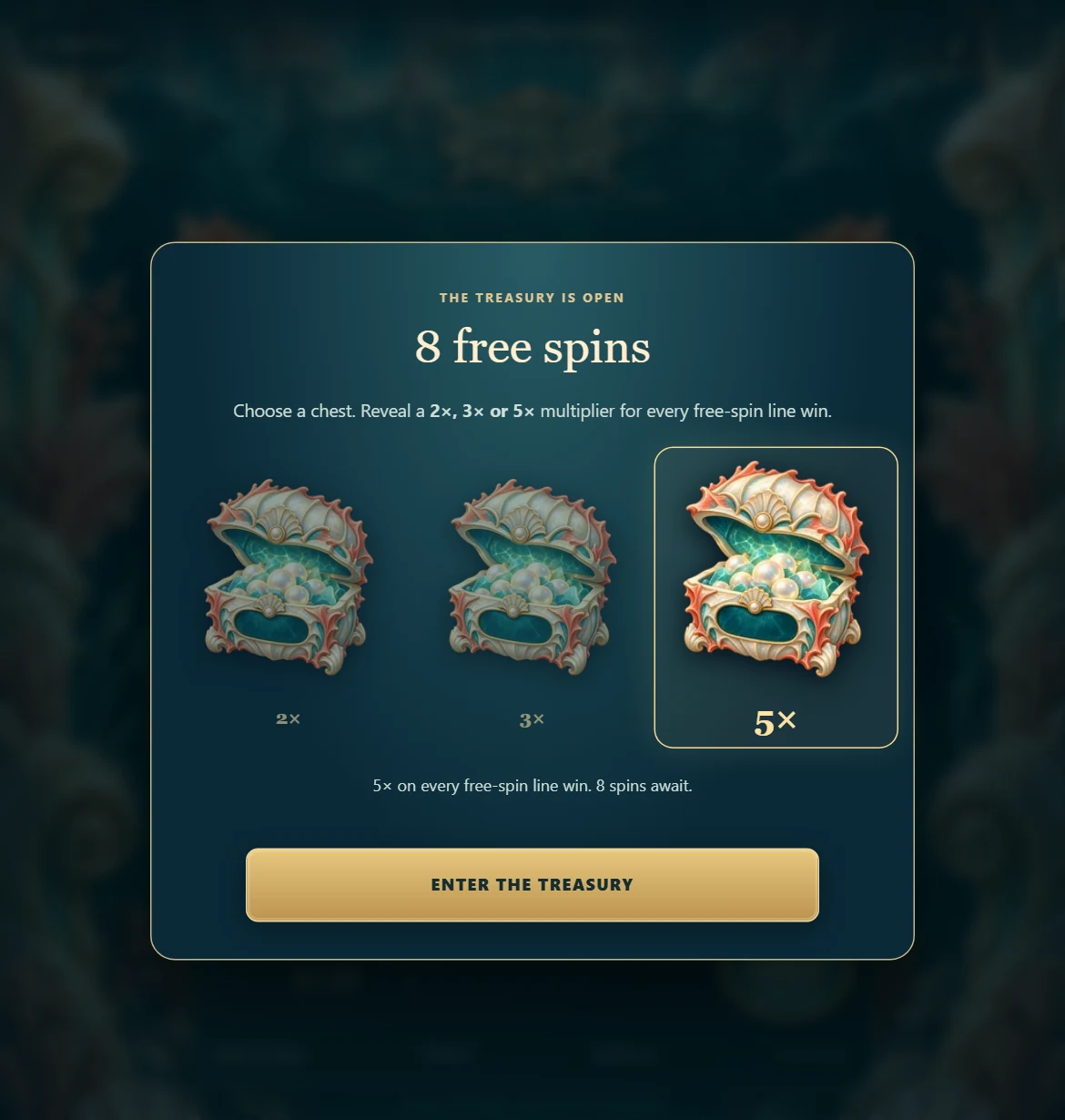
The triggering paid spin settles its ordinary line wins at 1×. The chest multiplier begins with the free spins, whose payout basis stays locked to the triggering bet.
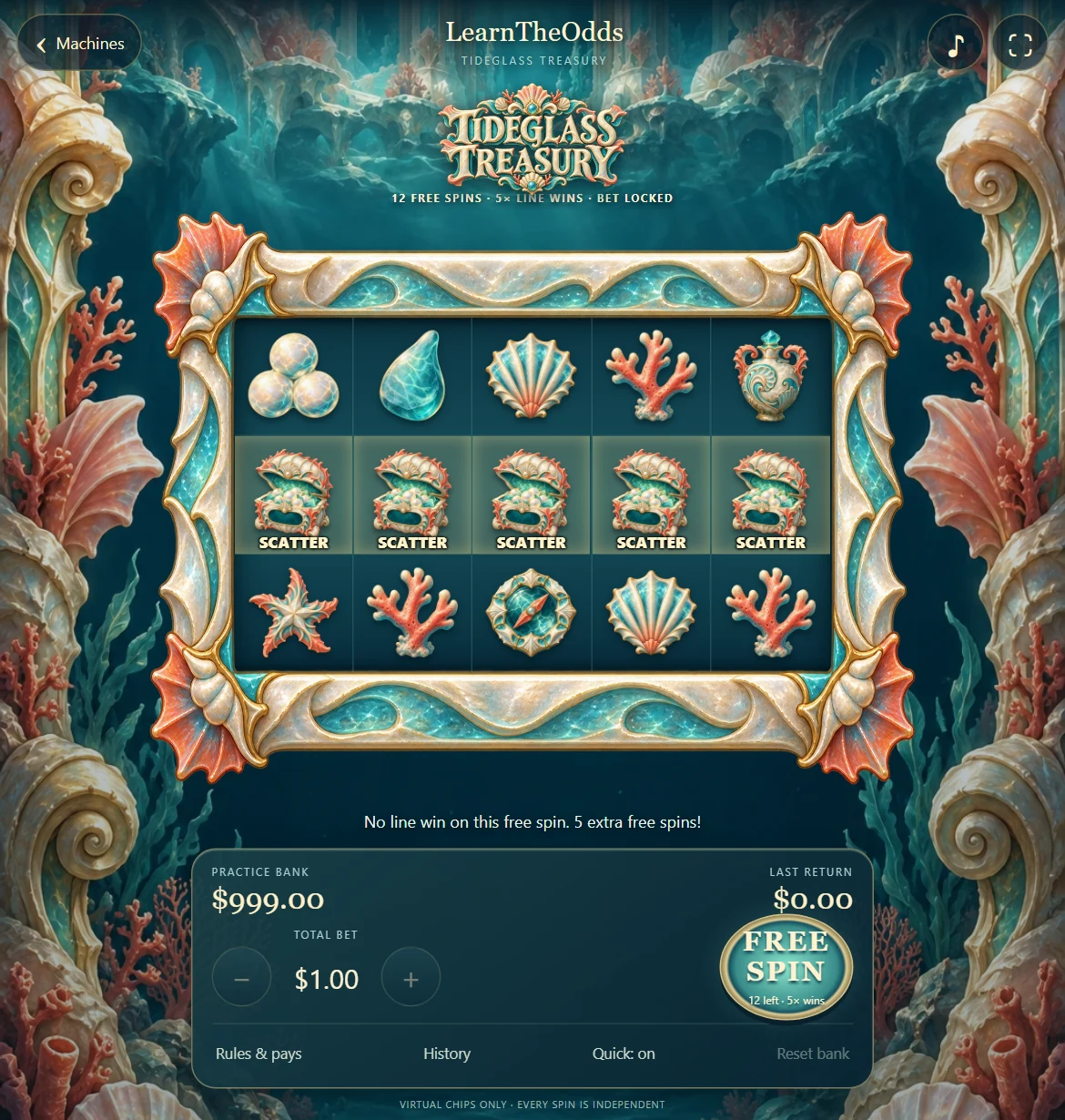
During a free spin, three or more scatters add five spins, whether three, four, or five chests appear. There is no retrigger cap in this model. Extra spins retain the same bet and multiplier.
Suppose eight free spins begin, and the first one retriggers. Playing it uses one spin, leaving seven; adding five brings the counter to 12. There will be 13 spins in the feature if none of those 12 retriggers again.
How weighted reels determine bonus odds
Picture each reel as a circular strip of 36 numbered tickets. The game chooses one ticket uniformly as the center position, then shows the neighboring tickets above and below it. The symbols on those three positions are connected by the strip. They are not three separate draws.
The five reel stops are drawn independently. Because each strip contains six Sea glass symbols, a particular row on a reel has a 6/36, or 1/6, chance of showing Sea glass. The Wild chance is 2/36, or 1/18. The probabilities come from copies on the strip, not from how prominent the artwork looks.
One Scatter sits on each strip. Three center stops reveal it: stopping directly on it, immediately before it, or immediately after it. Therefore a reel has a 3/36 = 1/12 chance to show a Scatter somewhere in its three-row window. It can show at most one.
For exactly three Scatters, choose the three reels that show them. There are 10 possible sets of three reels. Each set has probability (1/12)^3 × (11/12)^2, because the other two reels must miss.
The corresponding calculations are:
| Scatter count | Probability calculation | Chance per paid spin |
|---|---|---|
| Exactly 3 | 10 × (1/12)^3 × (11/12)^2 | 0.486272% |
| Exactly 4 | 5 × (1/12)^4 × (11/12) | 0.022103% |
| Exactly 5 | (1/12)^5 | 0.000402% |
| Any trigger | Add all three probabilities | 0.508777% |
That is about one trigger per 196.55 paid spins on average. It is not a countdown. The chance of no bonus across 200 paid spins is approximately 0.99491223^200 = 36.05%.
After such a run, the next paid spin still has the same 0.508777% trigger chance. Within a bonus, the game remembers the chosen multiplier and remaining spins, while each new set of reel stops remains independent.
Calculating the return from ordinary line wins
An average payout is a weighted shopping basket: multiply each possible return by its probability, then add the results. A large prize with a tiny probability contributes less than its headline amount suggests.
For one Tideglass payline, there are 12 symbol types at each of five positions, giving 12^5 = 248,832 symbol sequences to consider. They are not equally likely. A sequence’s probability is the product of its five symbol weights divided by 36 five times.
To reproduce the calculation, take each sequence, find the highest valid award using the paytable and wild rules, multiply that award by its probability, and add all the contributions. Nonpaying sequences contribute zero.
For example, five actual Sea glass symbols have probability (6/36)^5 = 1/7,776. Their 90× line award contributes 90/7,776, approximately 0.011574, to the average return per unit of line bet. Wild-assisted combinations are additional sequences, evaluated separately so the highest award is counted only once.
Adding all sequences produces 0.8395798669 returned per unit of line bet. All 20 lines have the same individual distribution because every row samples the same symbol counts. Twenty equal line stakes therefore produce the same 83.957987% return relative to the total bet.
The paylines share positions and can win together, so their results are correlated. That matters for the size of swings, but it does not prevent us adding their average returns. You can add the average spending of two household members even when they shop together.
This is the paid-spin line return before adding future bonus spins. It is not the complete game RTP.
Adding free spins and retriggers to RTP
First, calculate how many free spins paid play creates. Multiply each trigger probability by its initial award and add:
8 × P(3 scatters) + 12 × P(4 scatters) + 20 × P(5 scatters)
The result is 0.04163451646 initial free spins per paid spin. Conditional on actually triggering, that averages about 8.1833 initial spins.
Next, account for the extra spins those spins can create. Call the trigger probability q = 0.0050877700617. A free spin adds five more spins with probability q, so each free spin creates 5q = 0.02543885031 further spins on average.
Imagine a batch of invitations where each invitation occasionally generates more invitations. You must count the first batch, the second generation, and every later generation. Here that gives:
initial spins × (1 + 5q + (5q)^2 + ...)
Because 5q is less than one, the total has a finite average. Dividing the initial figure by 1 - 5q gives 0.04272129714 free spins per paid spin, including all retriggers. A triggered feature averages about 8.3969 spins in total.
The average chest multiplier is (2 + 3 + 5) / 3 = 10/3, approximately 3.3333. It is independent of the reel results. Free spins use the same strips and paytable, so their average return is the ordinary 0.8395798669 multiplied by 10/3, or 2.7985995564 times the triggering total bet per free spin.
Combine those pieces:
| Part of the calculation | Return per $1 of paid wagers |
|---|---|
| Paid-spin line returns | $0.839579867 |
| Free spins, including multipliers and retriggers | $0.119559803 |
| Total | $0.959139670 |
The bonus contribution is 0.04272129714 × 2.7985995564. Adding it to the paid-spin return gives 95.913967% theoretical RTP, leaving a 4.086033% expected loss rate.
These are exact expectations for the specified model, rounded for display, rather than estimates from a sample of simulated sessions. They do not describe the commercial games mentioned earlier or amount to independent casino certification.
At $1 per paid spin, 1,000 paid spins represent $1,000 in wagers. Their expected total return, counting completion of all earned bonuses, is about $959.14, an expected net loss of $40.86. A particular session can finish far above or below that average. Free spins contribute to the return without adding new wagers to the denominator.
Frequently asked questions
Is the 5× chest the best choice?
Revealing 5× gives the largest multiplier, but all three chest positions have the same chance of containing it. There is no best position to choose.
Does a retrigger increase the multiplier?
Not in Tideglass. It adds five spins at the existing multiplier. Other games may change multipliers on retriggers, so the name alone cannot tell you the rule.
Can a free-spin feature return nothing?
Yes. Neither the initial spins nor the multiplier guarantees a paying line. Multiplying a zero return still gives zero.
Does a larger bet improve the bonus chance?
No. Every available bet uses the same reels and trigger rules. Larger bets scale dollar returns and expected dollar losses proportionally.
Tideglass Treasury is an original practice model using virtual funds with no cash value. For help reading unfamiliar bonus rules, see Slot Bonus Features Explained.
Explore another bonus type
Compare this feature with three-pot slot bonuses in Lanternfox Market, or browse all six worked examples in the slot learning hub.