How Moving Wild Slots Work: Respins and Multipliers
Last reviewed: October 2026
A moving wild respin feature carries a wild to another position while other symbols get a fresh chance to land. The retained wild changes the next spin’s conditions. It still needs compatible symbols to make a paying combination.
Commercial games use several versions of this idea. In Jack and the Beanstalk, NetEnt describes wilds moving one reel left after each respin, with wins involving wilds tripled. In Piggy Riches 3: Hog Heaven, walking wilds move in opposite directions and their multipliers increase as they participate in winning combinations. These are related mechanisms with different rules. NetEnt’s Jack and the Beanstalk guide and Piggy Riches 3 feature guide explain their respective movement and multiplier systems.
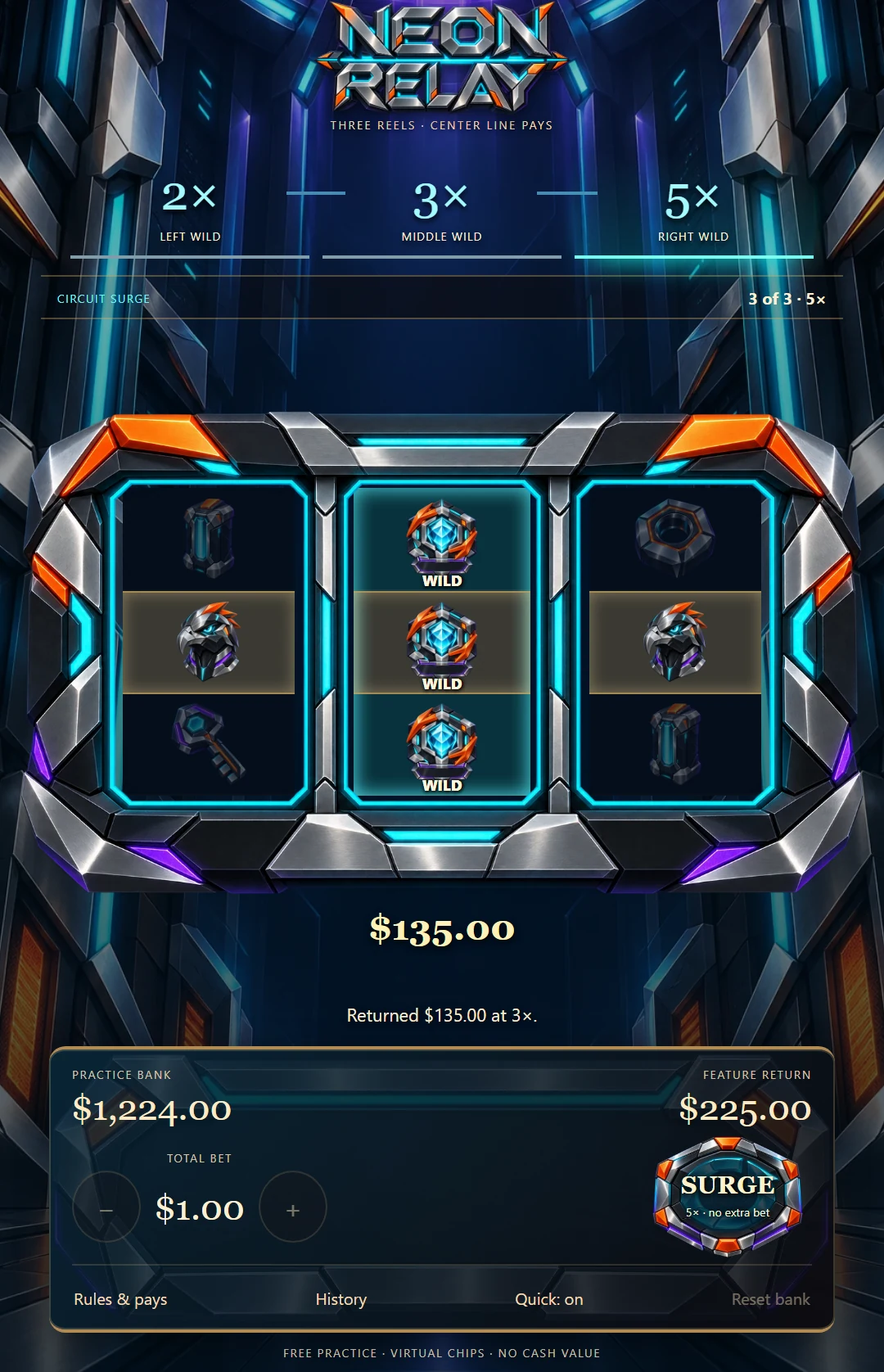
Our worked example, Neon Relay, uses a simpler original design. Its Circuit Surge feature supplies exactly three free respins. A whole reel becomes wild, moving from left to middle to right, while the line multiplier advances from 2× to 3× to 5×. The practice game’s rules and math are independent of those commercial titles.
Jump to: Play · How it plays · Bonus rules · The math · Questions
Play Neon Relay
A moving wild reel with 2×, 3× and 5× respins

$1,000 practice bank · Free play · No cash value
Open a separate game in a full window ↗ Loading your game… Taking a while? Use the full-window link to open the game directly.Walking wilds, expanding wilds, and free respins
These terms describe different parts of a feature:
| Term | What it describes |
|---|---|
| Walking or moving wild | A wild changes its position between spins |
| Expanding wild | A wild covers additional positions, often a whole reel |
| Sticky wild | A wild remains in a specified position for a stated period |
| Respin | Another reel result under the feature’s rules |
| Multiplier | A factor applied to a qualifying return |
One feature can combine several of them. Neon makes a full reel wild for each respin, but the previous reel does not stay wild when the feature moves to the next stage. A naturally drawn wild may still appear there.
The multiplier follows a fixed schedule. Winning or losing the first respin does not affect whether the second receives 3×. Nor does the 5× stage multiply the money already collected on earlier respins.
Imagine a three-stop route with a different payment rate at each stop. The game remembers which stop comes next, but it draws fresh symbols for the reels that are not forced wild.
One payline and the complete payout table
Neon Relay has three reels with three visible symbols each. Only the horizontal center line pays or triggers the feature. Symbols immediately above and below are the neighboring stops on each reel strip; they do not create extra paylines.
There is one active line, so the line bet and total bet are the same. The available bets are $1, $2, $5, $10, $20, and $50 in virtual funds. All payouts below are multiples of the total bet. The dollar examples and screenshots use a $1 total bet.
| Symbol | Three matching, with eligible wilds | Copies on each 64-stop reel |
|---|---|---|
| Charge Battery | 2× | 14 |
| Pulse Plug | 4× | 10 |
| Titanium Hexnut | 5× | 8 |
| Cipher Key | 6× | 6 |
| Optic Chip | 8× | 5 |
| Plasma Cell | 12× | 4 |
| Neon Coil | 18× | 3 |
| Drone Beacon | 25× | 3 |
| Turbine Rotor | 35× | 3 |
| Relay Falcon | 45× | 3 |
| Relay Core Wild | 80× | 4 |
| Access Pass Scatter | No symbol payout | 1 |
Relay Core Wild substitutes in three-symbol combinations, but it cannot replace an Access Pass. Three Wilds pay their own 80× award. A line such as Relay Falcon, Wild, Relay Falcon returns 45× the bet.
There are three smaller award rules:
- Any three symbols from the first five types, including Wilds, return 0.5× if there is no higher award.
- An actual Charge Battery on the first reel returns 0.5× if there is no higher award.
- Actual Charge Batteries on both the first and second reels return 1× if there is no higher award.
The first five types are Charge Battery, Pulse Plug, Titanium Hexnut, Cipher Key, and Optic Chip. Wild substitution applies to their three-symbol combinations, including the mixed-symbol award. It does not apply to the one-Battery or two-Battery rules.
Only the highest center-line award pays. Charge Battery, Charge Battery, Pulse Plug therefore returns 1×, rather than adding the 1× Battery award and the 0.5× mixed-symbol award. At a $1 stake, that is a $1 return and zero net profit.
Charge Battery, Access Pass, Relay Falcon returns 0.5×, or $0.50 at that $1 stake. Receiving money back does not make it profitable: the net result is a $0.50 loss. For more on this distinction, see How to Read a Slot Paytable.
What triggers the three multiplier respins?
An Access Pass in reel three’s center position starts Circuit Surge on a paid spin. An Access Pass on either of the other reels, or above or below the center line, does not trigger it.
The trigger symbol can coexist with a Battery return. Charge Battery, Charge Battery, Access Pass returns 1× on the paid spin and starts the feature. That base return is separate from the later respins.
The three stages are fixed:
| Respin | Entire reel made wild | Multiplier on that respin’s line return |
|---|---|---|
| 1 | Left | 2× |
| 2 | Middle | 3× |
| 3 | Right | 5× |
Each respin uses the locked triggering bet and costs no additional stake. The other two reels draw fresh independent stops. Access Passes during the feature do not retrigger it, and there are no extra respins after the third.
Each result is credited when that respin finishes. The feature summary shows their total; collecting or closing that summary does not award the same money again.

A complete dollar example
Suppose a $1 paid spin shows Pulse Plug, Titanium Hexnut, Access Pass on the center line. That returns $0 immediately and starts Circuit Surge.
The following are hypothetical feature outcomes:
| Stage | Center row after the wild reel is applied | Calculation | Return |
|---|---|---|---|
| 1 | Wild, Plasma Cell, Plasma Cell | 12 × $1 × 2 | $24 |
| 2 | Charge Battery, Wild, Access Pass | 0.5 × $1 × 3 | $1.50 |
| 3 | Pulse Plug, Titanium Hexnut, Wild | 0.5 × $1 × 5 | $2.50 |
The second row pays only the actual first-reel Battery award. Its Wild cannot replace the Access Pass or count as a second actual Battery. The third row qualifies for the mixed low-symbol award.
Total feature return is $28. With no base return and a single $1 triggering wager, the complete paid-spin cycle has a $27 net profit. This is an arithmetic example, not a prediction of a typical bonus.
How the reel weights determine the odds
Neon Relay shares its base reel strips and partial-award rules with Copper Canyon and Velvet Sevens. Its paytable is different: three Batteries pay 2×, three Falcons pay 45×, and three Wilds pay 80×. Comparing its full RTP therefore includes both those lower line awards and the moving-wild bonus.
Each reel contains 64 equally likely stops. The counts in the paytable sum to 64, so you can think of the reel as a bag of 64 numbered tickets. Four tickets say Wild, three say Relay Falcon, and one says Access Pass.
Every spin draws a fresh stop independently for each reel. Charge Battery has probability 14/64 = 21.875% at the center; Relay Falcon has probability 3/64 = 4.6875%. Twelve different symbol types do not mean each has a one-in-twelve chance.
Because only the third reel’s center Access Pass triggers Circuit Surge, the feature probability is simply 1/64 = 1.5625% per paid spin. There is no need to multiply by a chance on the other reels, because they can show anything.
An average of one trigger per 64 paid spins does not promise one within every block of 64. The chance of no trigger in 64 paid spins is (63/64)^64, approximately 36.50%. After 100 misses, the next paid spin still has a 1/64 chance.
Feature state is a separate matter. Respin three has a guaranteed right wild reel and 5× multiplier because the rules put it there. Its fresh stops on the remaining reels are random and unaffected by previous wins or losses.
Calculating the base-game return
To calculate an average return, multiply each outcome’s probability by what it pays, then add. The reel weights and all award rules above provide everything needed for this part of the model.
There are 64 × 64 × 64 = 262,144 equally likely stop combinations. You can evaluate every combination directly. A shorter equivalent calculation groups them into 12 × 12 × 12 symbol combinations, weighting each by the product of the three copy counts.
For example, Relay Falcon, Wild, Relay Falcon represents 3 × 4 × 3 = 36 stop combinations. Its probability is 36/262,144, about 0.013733%. Its 45× payout contributes 45 × 36 / 262,144, approximately 0.006180, to average return per dollar bet. Other Falcon arrangements contribute separately.
There is also a convenient way to group all 45× Falcon wins at once. Each reel may contain a Falcon or Wild, giving seven eligible stops per reel. Remove the all-Wild cases because they pay 80× instead:
(7^3 - 4^3) / 64^3 = 279 / 262,144
Those outcomes contribute 45 × 279 / 262,144, approximately 0.047894, to base return per dollar. The subtraction prevents paying the same all-Wild outcome twice.
For each ordinary symbol with weight w and three-symbol payout p, the same method gives a contribution of p × ((w + 4)^3 - 4^3) / 64^3. Add those ten contributions, then add 80 × 4^3 / 64^3 for three Wilds.
Finally evaluate the lower awards only where no higher award already applies. Across all stop combinations, 109,448 pay exactly 0.5× and 9,016 pay exactly 1×. Their contributions are 0.5 × 109,448 / 262,144 and 9,016 / 262,144. The remaining nonwinning outcomes contribute zero.
Adding all these mutually exclusive returns gives 0.5724525452 per dollar bet, or 57.245255%. This is only the base-game contribution. The earned feature supplies a substantial additional portion of the full return.
Calculating moving-wild bonus value and total RTP
A forced wild leaves only two random center symbols to consider. Each stage therefore has 64 × 64 = 4,096 equally likely pairs. Put the guaranteed Wild in its assigned position, calculate the best line award for each pair, add the awards, and divide by 4,096.
As one example, during the first respin, both random reels showing actual Plasma Cells has probability (4/64)^2 = 1/256. Wild, Plasma Cell, Plasma Cell pays 12× before the stage multiplier. With 2× applied, that case contributes 24/256 = 0.09375 to the first respin’s expected return per dollar of triggering bet.
Repeating the calculation for every pair gives:
| Forced wild position | Average line return before multiplier | Stage multiplier | Average stage return |
|---|---|---|---|
| Left | 2.350830078× | 2× | 4.701660156× |
| Middle | 2.379882813× | 3× | 7.139648438× |
| Right | 2.379882813× | 5× | 11.899414063× |
Why is the left stage’s unmultiplied value slightly lower? The special partial awards require an actual Battery on reel one. Replacing that reel with a Wild removes those partial awards, even though it helps complete three-symbol combinations. The middle and right placements have equal averages in this model.
Add the three stage averages to obtain 23.740722656× the triggering bet per Circuit Surge feature. At a $1 triggering stake, that is an average feature return of about $23.74. An individual feature can return zero or substantially more than this average.
The feature occurs with probability 1/64, so its contribution per dollar of paid wagers is:
23.740722656 / 64 = 0.3709487915
That adds 37.094879 percentage points to the 57.245255% base contribution. The complete theoretical RTP is therefore 94.340134%, and the expected loss rate is 5.659866%.
This result comes from exact weighted enumeration of the specified practice model, with the bonus expectation added analytically. It is not a sample-session estimate or a claim about any commercial machine’s mathematics or certification.
For 1,000 paid spins at $1 each, total wagers are $1,000. Counting all returns and completing all earned features, expected return is approximately $943.40, leaving an expected net loss of $56.60. Free respins create returns but add no new wagers. Actual session results can vary widely.
Circuit Surge always ends after its third respin. Its feature maximum is 80 × (2 + 3 + 5) = 800× the triggering bet, requiring an all-wild center line on all three stages. At a $1 bet that is $800. There are no retriggers to extend that ceiling.
Frequently asked questions
Does a full wild reel guarantee a win?
No. The other symbols still matter. Wild, Access Pass, Relay Falcon has no qualifying award, so even a multiplier leaves its return at zero.
Do the 2×, 3×, and 5× multipliers combine into 30×?
No. Each factor applies only to its own respin. Calculate three separate returns and add them.
Can Access Passes extend Circuit Surge?
No. It always lasts three respins. A pass on a free respin cannot restart or extend the feature.
Does betting more improve the trigger chance?
No. It remains 1/64 at every available bet. A higher stake increases dollar awards and expected dollar losses in the same proportion.
Neon Relay is an original LearnTheOdds practice model. Virtual funds cannot be purchased or cashed out, and the example is intended to teach how bonus rules and probabilities fit together.
Explore another bonus type
Compare this feature with prize and multiplier wheel bonuses in Velvet Sevens, or browse all six worked examples in the slot learning hub.