Cruise Ship Slot RTP: What Real Machine Meters Show
Last reviewed: July 2026
No cruise line publishes the payback percentage of its slot machines, so nobody can quote you a real number; they can only guess. The consensus guess among experienced cruisers is 80–85% RTP (a 15–20% house edge). The machine meters we have been able to read tell a more nuanced story. Three lifetime meters measured 90.1%, 87.1% and 83.3%, and a fourth machine’s own setup screen listed a configured RTP range of 86.9–90.9%. Four readings across four ships and two cruise lines, not a floor average, but the first public, verifiable datapoints, and a lot more than folklore.
The sharpest finding is that two of these are the same game. Huff N’ More Puff measured 90.1% on Icon of the Seas and 83.3% on Liberty of the Seas, a 6.8-point spread on an identical title. Three of the four readings come from a photographed machine screen, credited and dated; the fourth was transcribed from the meters by a cruiser and is labelled as such. This page will grow as more meters surface.
Higher is better for the player. The cruise figures were photographed on the machines themselves; the assumed band is folklore, shown for contrast. Nevada's average covers every denomination, including high-limit machines that pay far better than pennies, and is the closest published land benchmark, since state reports don't isolate penny slots cleanly.
Why nobody knows the real number
Land casinos are measured. State regulators publish slot results every month; the Nevada Gaming Control Board and New Jersey’s Division of Gaming Enforcement both post the reports. Analyzing that data, the UNLV Center for Gaming Research found Nevada’s statewide slot hold averaged 7.1% in 2025 (up from 6.55% in 2004), roughly a 93% return across every machine in the state.
One caveat that matters for the comparison below: those state reports are less useful per-denomination than they look. Video poker, video keno, and electronic table games get counted inside the slot numbers, and electronic table games usually land in the penny category, because penny units are what’s needed to pay odds on bets like craps Place and Buy. So the published “penny slot” hold is diluted by lower-edge games, and no clean public penny-versus-penny benchmark exists. The statewide 93% average is the honest anchor, and it spans everything from pennies to high-limit dollar machines, which pay considerably better.
Cruise ships are not. A casino at sea sits in international waters, bound by no jurisdiction’s minimum-payback law and no public-reporting regime. Par sheets are not published, and operators decline to answer, Carnival’s own guidance is that the floor changes too often to document. Compounding it, the same game title ships in multiple RTP configurations, and the operator chooses which one to buy. Knowing that a machine is “Huff N’ More Puff” tells you nothing about its setting. That vacuum is exactly why “cruise slots are tight” circulates as folklore with no numbers attached, sometimes true, never sourced.
What a machine meter is, and why it settles arguments
Every electronic slot keeps lifetime meters for audit and service purposes: total money wagered, total money won, games played, games won. They live behind an attendant or operator menu, and occasionally an attendant leaves that menu open. A clear photo of it tells the whole story, because:
RTP = total money won ÷ total money wagered, measured over the machine’s entire metered life: hundreds of thousands of spins, not a session and not a feeling. That is a real, large sample.
Three honest caveats, stated up front:
- A progressive jackpot paid inside the meter window inflates lifetime RTP relative to what the base game pays on an ordinary day. Where the event log shows a jackpot handpay, treat the measured figure as a ceiling on the everyday experience.
- One machine is not the floor. Casinos deliberately mix settings across a bank. A loose reading does not mean the machine next to it matches.
- Meters can be reset at refurbishment, so a lifetime figure covers “since the last reset,” not necessarily since install.
On sample size: at 134,000–290,000 games these are not small samples, and they comfortably rule out the 80–85% folklore band. They are still not enough to pin a machine’s true RTP to the decimal. A Diamond-tier player made the point directly, and it is correct: on a high-volatility game with a jackpot in its history, even ~180,000 spins can sit a point or more away from the configured number. That is exactly why the Anthem reading below carries more weight than its lack of player results suggests; a setup screen reports the setting the operator chose, with no variance in it at all. Read the meters as “what these machines actually paid,” and the setup screen as “what this machine was set to pay.”
Machine 1: Huff N’ More Puff, Icon of the Seas
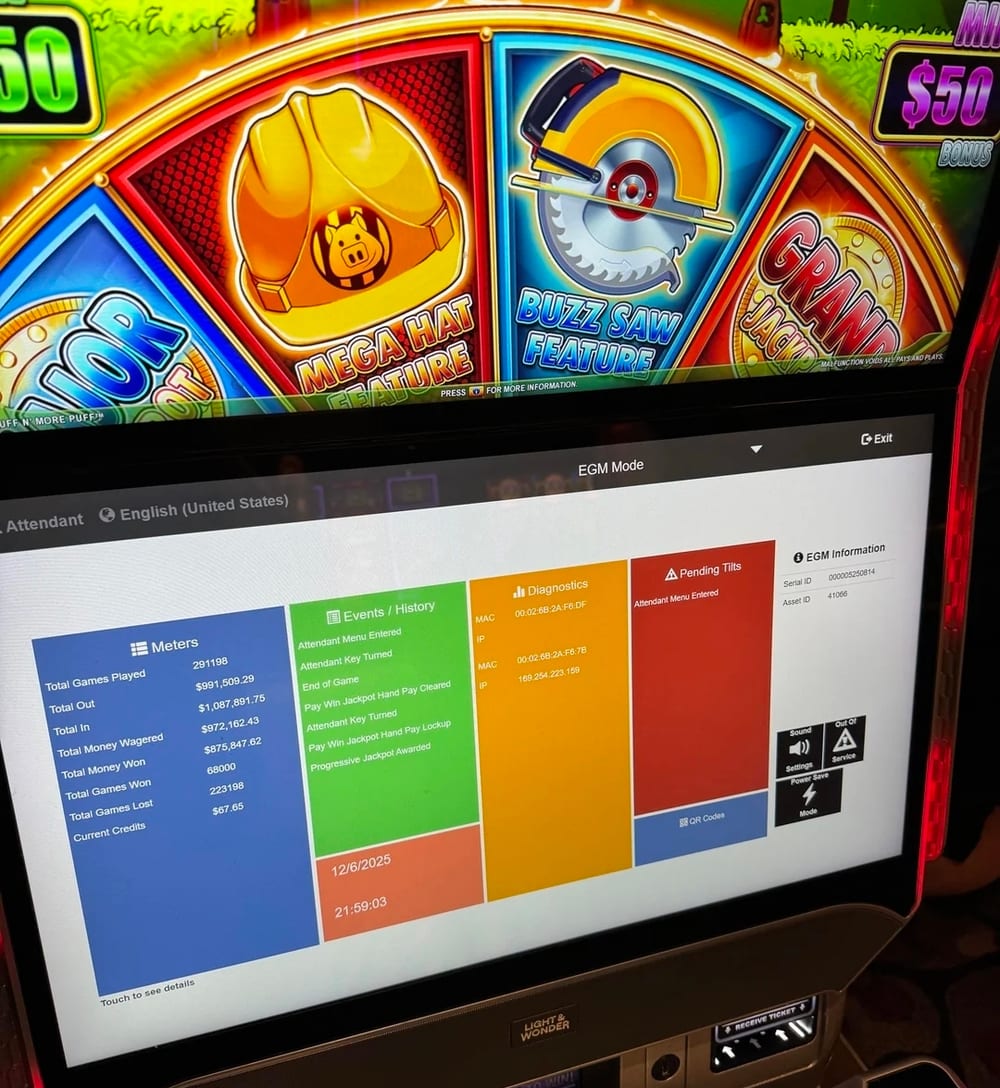
| Meter | Reading |
|---|---|
| Total money wagered | $972,162.43 |
| Total money won | $875,847.62 |
| Measured RTP | 90.1% (9.9% hold) |
| Games played | 291,198 |
| Games won | 68,000 → 23.4% hit frequency |
At 90.1%, this Light & Wonder machine ran meaningfully looser than the 15–20%-edge folklore, though still about three points tighter than Nevada’s statewide slot average. One catch: the machine’s event log shows a progressive jackpot handpay, so 90.1% is best read as the ceiling of what the base game pays day to day. This machine happened to be measurable (it was whichever menu an attendant left open, not one that was cherry-picked) which is worth stating plainly.
Machine 2: Dragon Link, Carnival Jubilee
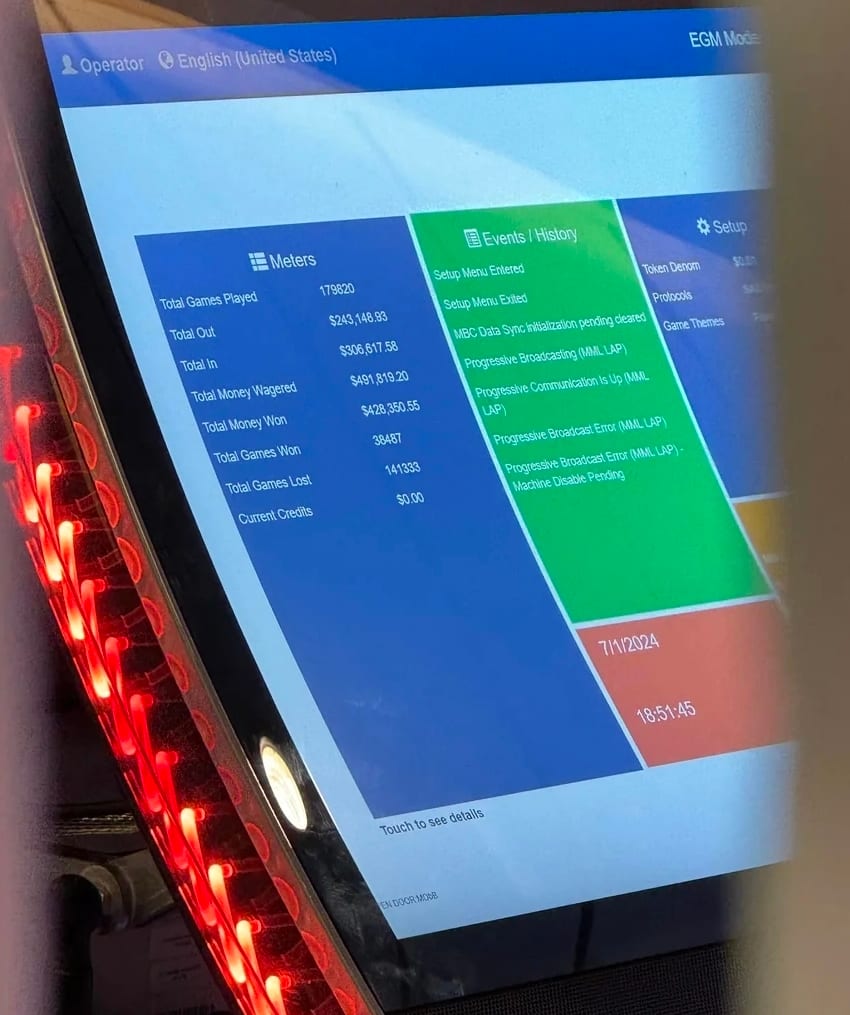
| Meter | Reading |
|---|---|
| Total money wagered | $491,819.20 |
| Total money won | $428,350.55 |
| Measured RTP | 87.1% (12.9% hold) |
| Games played | 179,820 |
| Games won | 38,487 → 21.4% hit frequency |
A second line, a different manufacturer, a different game, and it lands in the same neighborhood, three points below the Icon reading. That spread between two machines is exactly the point about mixed settings: the machine you sit at matters. The next reading makes that point far more sharply, because it is the same game as the first.
Machine 3: Huff N’ More Puff again, Liberty of the Seas
The same title as Machine 1, on a different Royal Caribbean ship. These figures were transcribed from the meters by a cruiser rather than photographed, so they sit a step below the photo-backed readings above; we publish them because the numbers are internally consistent and the contributor had no reason to shade them, but they are labelled honestly.
| Meter | Reading |
|---|---|
| Total money wagered | $254,822.50 |
| Total money won | $212,276.06 |
| Measured RTP | 83.3% (16.7% hold) |
| Games played | 134,021 |
| Games won | 31,637 → 23.6% hit frequency |
Figures shared by a cruiser who asked for no credit.
The clearest proof on this page: same game, two ships
This is the single most useful thing on the page, because it settles a question people ask constantly: is this game good? The game is not good or bad. The configuration is, and the operator picks it at purchase. A title you had a great night on aboard one ship can be set several points tighter on the next one, with nothing on the cabinet to tell you.
Note too that the hit frequencies are nearly identical, 23.4% against 23.6%. The tighter machine is not paying out less often; it is paying out less. Volatility feels the same in the seat while the money drains faster, which is precisely why you cannot feel a setting.
Pooled, the three lifetime meters cover about $1.72 million of wagering across 605,000 games, of which roughly 88% came back. That figure mixes two titles across three ships and is not a fleet average, but it is a real aggregate, and it is nowhere near the folklore number.
Machine 4: the setup screen itself, Anthem of the Seas
The strongest reading isn’t a measurement at all, it’s the machine telling you its own configuration. On a Wonder 4 Jackpots cabinet aboard Anthem of the Seas, the operator setup menu was open to the accounting page:
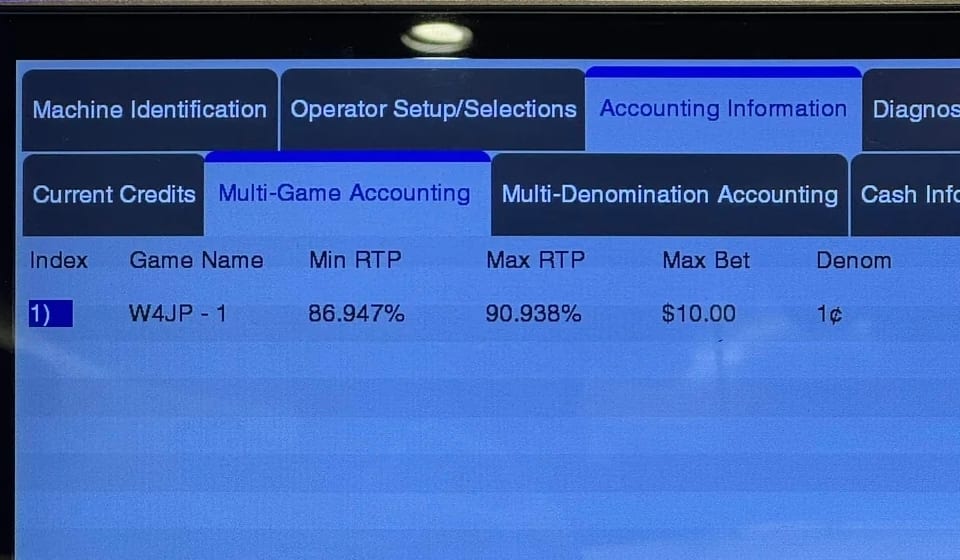
The screen lists the installed game (W4JP-1) with a configured RTP range of 86.947% to 90.938% at a 1¢ denomination. This is not player results that could be skewed by variance or a jackpot, it is the paytable configuration the operator selected, read straight off the machine. It corroborates the lifetime meters from a completely independent angle: the setting itself sits inside the same 83–91% band the measured play produced, and near the top of it.
A note on the two meter pairs
Sharp-eyed readers will spot that the attendant screens show two money pairs. On the Icon machine, “Total In / Total Out” reads $1,087,891.75 / $991,509.29, a different ratio (91.1%) than the 90.1% above. That second pair is cash and ticket flow through the machine’s bill validator and printer (cage accounting), not the wagering handle. RTP is won-vs-wagered, so this page uses the Total Money Wagered / Total Money Won meters. The two pairs even swap order between machines, on the Jubilee cabinet cash-in is below money wagered, which is exactly what you’d expect from two meters measuring different things.
What this does not mean
The credibility of this page is the product, so the limits matter as much as the numbers:
- It does not mean cruise slots are “fine.” A ~10% hold is still 2–3× a decent land video-poker edge and worse than most table games played well.
- It does not mean every machine. Banks are mixed; the floor certainly holds tighter settings than the loosest one measured. The 6.8-point gap between the same game on Icon and Liberty proves it.
- It does not mean you can pick the loose one. The setting is invisible from the seat.
- It does mean the honest planning range is wider than folklore, and kinder at the top end than “80–85%.” Plan conservatively (our tools default to a cautious payback assumption), expect reality may run better, and measure your own.
Measure your own effective edge
You don’t need an attendant to leave a menu open to learn something. Your effective hold is your net loss divided by your total coin-in, and over enough sessions it converges on what you’re actually experiencing. It’s a messier measurement than a machine meter (your play mixes machines, may include lower-edge video poker, and carries real variance) so it takes a lot of logged sessions before the number means much. But it’s the one measurement you can always take.
Our Club Royale casino tracker computes it automatically, flags when your sample is still too small to trust, keeps everything on your device, and works offline at sea. One cruiser’s meter photo settles one machine; a thousand cruisers’ tracked sessions would settle the fleet. For how payback and swing interact, see slot RTP and volatility and slot hit frequency.
If you want to feel what an 83% machine does to a bankroll versus a 91% one, our slots simulator lets you set the payback and run it. And if the casino has video poker, that’s the one machine on a ship whose return you can read off the glass before you sit down; the video poker simulator prices all twelve common paytables exactly, including the short-pay schedules cruise floors favour.
Planning a specific sailing? Feed a payback assumption into the Club Royale certificate calculator to see the real expected cost of the play behind each cruise-certificate rung, and read why comps don’t make you a winner before you chase one.
Help grow this page
If you come across a machine with its attendant or setup menu already open, a clear photo of the meters page tells the whole story, send it and I’ll run the math and credit you. Only photograph what’s incidentally in view: don’t open menus, don’t ask crew, and don’t linger to catch a screen. That line protects you and keeps this data clean. Floor photos are welcome too, for the ship directory; the Ovation of the Seas slot list is an example of what those become.
Frequently asked
Is 90% good for a slot machine? It’s good for a cruise ship, where folklore says 80–85%. It is still a 10% house edge: worse than blackjack, baccarat, or full-pay video poker. “Better than expected” is not the same as “a good bet.”
Why do the machines disagree by so much? Because casinos install a mix of RTP settings, and the same title ships in several configurations. Huff N’ More Puff measured 90.1% on Icon and 83.3% on Liberty: same game, 6.8 points apart. That’s not a measurement error; it’s the whole reason you can’t know a specific machine’s payback from its name.
Does the progressive jackpot make 90.1% misleading? It makes it a ceiling. A jackpot paid during the metered life pushes lifetime RTP above what the base game returns on an ordinary spin, so the everyday experience is at or below the measured figure, not above it.
Contributor photos used with permission and credited to their source. Nothing here is supplied, endorsed, or reviewed by any cruise line or game manufacturer. Game titles are trademarks of their respective owners, named for identification only. Meters reflect one machine at one moment; floors and settings change.
Educational explanation only. No real-money gambling happens on LearnTheOdds.
Responsible gambling: Play for entertainment, not income; the math favors the house over time. Set limits, never chase losses, and if it stops being fun, take a break. 21+. Need help? Call 1-800-MY-RESET (1800myreset.org).